I’ve been sharing my life online since I was 14.
I didn’t do it behind a password-protected login. I didn’t hide behind an anonymous username. I attached my face and my name to it and shouted.
I was loud in the way a person becomes loud when they feel like they have nothing left to lose.
I was a teenage girl writing angsty blog posts, except mine weren’t primarily about boys or school or friends. I was writing about being sick. About symptoms I couldn’t explain. About doctors who couldn’t explain them either. About trying to build a normal adolescence around a body that was becoming increasingly impossible to live inside.
What Happened When I Got My Whole Genome Sequenced
Years later, I was accepted into a clinical trial at Baylor/Texas Children’s Hospital to have my whole genome sequenced.
It felt like someone had finally handed me the source code.
I remember getting access to that raw genetic data and immediately thinking: How do I get this into as many hands as humanly possible?
Could I copy it onto thousands of flash drives?
Could I somehow get a mailing list of geneticists and researchers and just mail them my DNA?
Could I sneak into a genetics conference and start handing out flash drives to anyone wearing a lanyard?
Here. Take it.
Please.
Find something.
Why Genetic Privacy Feels Different When You Have a Rare Disease
Because there is a particular desperation that comes with living inside a body medicine doesn’t completely understand. When you have an undiagnosed disease, a rare disease, or a disease that might kill you, the hypothetical future consequences of someone possessing your biological data can feel very different from the immediate consequences of nobody understanding it.
My disease has already invaded every supposedly private corner of my life.
Doctors know when I’m up all night on the bathroom floor. Insurance companies know what medications I take. Strangers have examined parts of my body I wouldn’t show most people I love. My medical history has influenced where I work, whether I travel, what I eat, how I sleep, what I spend, what I fear, and what I imagine my future looking like.
There is very little dignity left to protect when you’re writing about genetic privacy from that bathroom floor because your body has once again decided you’re not participating in normal human life today.
The universe has me at gunpoint when it comes to my disease.
So what exactly am I withholding?
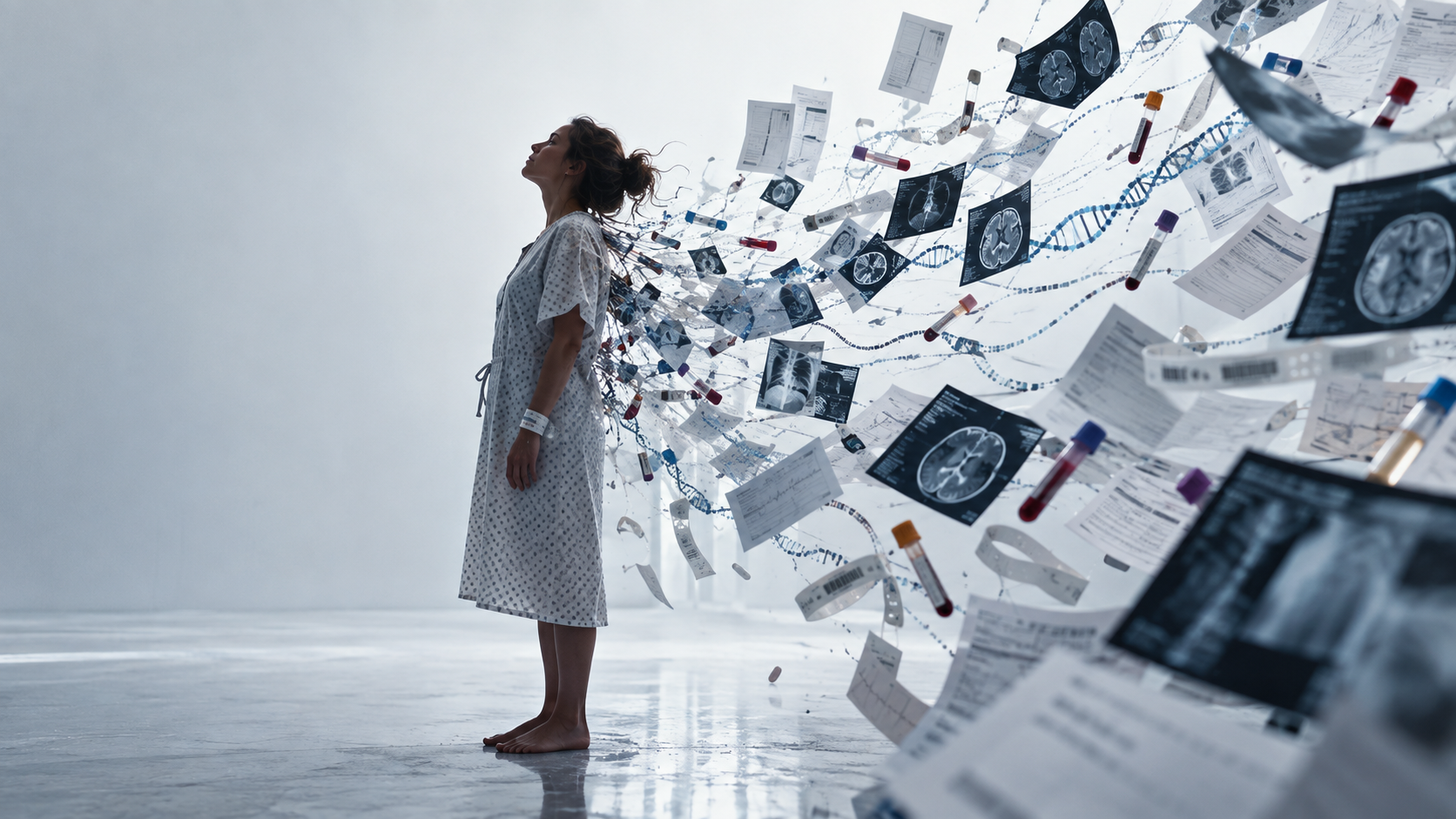
You want my genome? Take it.
You want my scans? Take them.
My bloodwork? Medication history? Failed treatments? Surgical reports? Symptom logs? Family history?
Do you want the embarrassing data? The inconvenient data? The abnormalities nobody has been able to explain? The things that happened once and never happened again?
Take those too.
I’m here for the reaping.
Take this entire puzzle apart and solve it.
I’m not offering my genome because I’m interested in some Silicon Valley fantasy about optimizing myself into immortality. I’m not trying to unlock the secrets of aging or engineer the perfect human.
I want answers.
And if my data cannot produce an answer for me, then maybe it becomes one tiny data point that helps produce an answer for somebody else.
The Right to Say Yes to Sharing Medical Data
I know privacy matters. I know there are very real reasons to protect genetic and medical information from discrimination, exploitation, commercialization, security breaches, and uses patients never agreed to. Informed consent matters. Patient control matters. The right to say no matters.
But the right to say yes matters too.
And sometimes I wonder whether the people designing systems to protect patients from sharing their data understand how badly some of us want to share it.
I have spent most of my life watching medicine try to solve a puzzle without enough pieces.
So take mine.
Study them. Compare them. Put them next to the pieces from ten other patients, or ten thousand.
Because I don’t want my medical data perfectly protected in a vault where nobody learns anything from it and it eventually dies with me.
If there is something inside my body—some mutation, pattern, laboratory anomaly, treatment response, bizarre combination of symptoms—that can move science one inch closer to understanding people like me, I want it out there.
Maybe it won’t save me.
But somewhere there is another sick 14-year-old girl sitting at a computer, desperately searching for the name of whatever is happening to her.
And if carving out a piece of myself and leaving it on the altar of science gets her an answer faster than I got mine?
Take whatever you need.